


Indoor growers are unlocking faster growth, stronger plants and cleaner harvests with one simple change: replacing traditional solid containers with net pots. These mesh-style plant holders may seem small and humble, but their impact is nothing short of transformative.
For hydroponic systems, aquaponics setups and soil-free growing environments, net pots are quickly becoming the container of choice. But what makes them so effective? The answer lies in how they interact with two critical elements in plant development: oxygen and water.
In this deep dive, we’ll explore the science behind net pot performance, explain why they outperform traditional pots in hydro gardening, and help you choose the best style and size for your setup.
Net Pots Unveiled: The Tiny Containers Making a Huge Impact
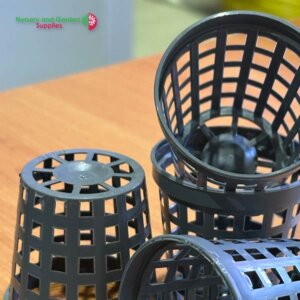
50mm Net Pot Grey
Net pots are small plastic containers made with open mesh sides and bases. Unlike solid pots, these containers are full of holes by design. The mesh allows water, air and nutrients to flow freely through the container while still holding the plant securely in place.
You’ll often see net pots in deep water culture (DWC), nutrient film technique (NFT), or aeroponic systems. But their use is not limited to hydroponics. They’re also ideal for aquaponics and even semi-hydroponic houseplant setups using leca balls.
Their popularity is not accidental. The design of net pots provides a unique advantage for growers looking to maximise plant health. While traditional pots confine roots and restrict water flow, net pots do the opposite. They expose the roots to more oxygen and eliminate stagnant zones where root rot typically forms.
In hydro systems, oxygenation is king. Without the ability to breathe, roots suffocate, growth slows and plants struggle. That’s where net pots shine.
Root Science: How Net Pots Supercharge Oxygen Intake
Roots need more than just water. To function efficiently, roots must absorb oxygen from their surroundings. In soil, this oxygen is present in tiny air pockets between soil particles. In hydroponics, it must be actively delivered through water that’s aerated with bubblers or pumped through systems.
According to the NSW Department of Primary Industries, maintaining adequate oxygen levels in the root zone is essential for nutrient uptake and plant health, with oxygen depletion quickly leading to reduced growth and root stress.
Net pots improve this oxygen exchange by allowing roots to grow through the mesh and dangle directly into oxygen-rich nutrient solutions. This contact boosts oxygen absorption, which in turn accelerates nutrient uptake and cell activity.
The roots become healthier, thicker and more efficient. They develop fine root hairs which absorb nutrients faster. These root systems are not only more productive, but also more resilient to disease.
Compare this to a standard solid plastic pot. Roots can become bound inside, circling around in a limited space with poor air access. This environment can encourage anaerobic bacteria and lead to root rot, a common plant killer in hydro systems.
Net pots also promote natural air pruning. As roots reach the edge of the pot and contact air, they stop growing and send signals to produce new root branches. This creates a dense and fibrous root structure, rather than a tangled mass. More roots mean more access to nutrients, leading to faster growth and larger yields.
The Smart Choice: Why Net Pots Outperform Traditional Planters
One of the most compelling reasons indoor gardeners switch to net pots is their efficiency. Water and nutrient distribution is far more even in net pots than in solid containers. In a hydroponic system, this makes a huge difference.
Traditional pots can create dry pockets or stagnant zones where roots don’t get enough nutrients. With net pots, the flow of solution surrounds the roots from all sides, reducing waste and improving consistency.
Another big win for net pots is root health. When roots are confined in a traditional pot, they often begin circling, a condition known as being root-bound. This limits the plant’s ability to take in nutrients and can stunt its growth. In net pots, roots grow outward into the surrounding medium or directly into the water. They get trimmed naturally by exposure to air or light, promoting a healthier and more extensive root system.
There’s also the question of hygiene. Net pots are easier to clean and reuse. Because they don’t retain organic material like soil or spongy inserts, there’s less risk of disease transmission between grows. A quick rinse and soak in sanitiser, and they’re ready for the next cycle.
Some growers worry that roots escaping through the mesh will get tangled or damaged. In practice, exposed roots in hydro systems are not only common but preferred. These free-hanging roots, known as “feeder roots,” are where most nutrient absorption happens. As long as your system maintains oxygen-rich water, these roots will thrive.
Net pots also make it easier to inspect root development. In clear systems, growers can monitor for signs of rot or disease early and adjust conditions before problems arise. This level of visibility is almost impossible in opaque containers.
Ready to Grow? Here’s How to Choose the Right Net Pot
Choosing the right net pot depends on the type of plant you’re growing and the style of hydroponic system you’re using.
For seed starting and small herbs, 50 mm to 75 mm net pots are ideal. These smaller sizes support seedlings without overwhelming them and work well in NFT or aeroponic towers.
If you’re growing leafy greens like lettuce or bok choy, 100 mm net pots offer more stability while still allowing full root access to nutrients. These are commonly used in deep water culture and raft systems.
For larger plants like tomatoes, peppers or cucumbers, opt for 125 mm or 150 mm net pots. These give your plant more room to grow while still keeping roots well oxygenated. You’ll often pair these with a support collar or lid insert in a bucket or tub system.
Pay attention to the shape as well. Most net pots are round, which fits easily into pre-drilled holes in raft boards or bucket lids. Some growers prefer square net pots for modular setups where space is limited. Both function the same in terms of oxygenation.
Durability also matters. Not all net pots are created equal. Some cheaper versions can become brittle or break under pressure. For Australian indoor growers, UV stabilisation is essential. This ensures your net pots don’t degrade under grow lights or exposure to sun in greenhouses.
Nursery and Garden Supplies Australia offers net pots that are purpose-built for our local conditions. They’re made from premium plastics, tested for UV resistance and designed for repeated use. Whether you’re just starting your hydro journey or scaling up a commercial setup, having reliable containers makes all the difference.
Each product comes with clear sizing information, and you can buy in volume to unlock tiered pricing. Orders ship fast from their Queensland warehouse and standard shipping is always free across Australia.
The Best Net Pots for Indoor Farming Start Here
With over 35 years in horticulture, Nursery and Garden Supplies Australia delivers premium, UV-stabilised net pots designed for serious indoor growers. Whether you’re scaling a hydroponic setup or experimenting with your first DWC system, the right container makes all the difference.
Order online today with free shipping Australia-wide or call Matt or James on 0490 503 674 for expert guidance.
FAQ
1. Why are net pots better than traditional solid pots in hydroponics?
Net pots allow far better oxygen and water flow around the roots. The mesh design lets nutrient solution and air move freely, reducing stagnant zones and root rot. This leads to faster growth, stronger plants and more efficient nutrient uptake compared to solid containers.
2. How do net pots improve root health and nutrient absorption?
Net pots let roots grow through the mesh and directly into oxygen-rich nutrient solution. This boosts oxygen intake and encourages fine feeder roots, which absorb nutrients more efficiently. The open design also supports natural air pruning, creating a dense, fibrous and healthier root system.
3. What types of systems are net pots best suited for?
Net pots are ideal for deep water culture (DWC), nutrient film technique (NFT), aeroponics and aquaponics. They also work well for semi-hydroponic houseplants grown in media such as leca, where drainage and aeration are critical.
4. What size net pot should I use for different types of plants?
For seed starting and small herbs, 50–75 mm net pots are usually sufficient. Leafy greens like lettuce or bok choy perform well in 100 mm pots. Larger crops such as tomatoes, peppers or cucumbers generally need 125–150 mm net pots for greater stability and root volume.
5. Are NGS net pots reusable and suitable for Australian conditions?
Yes. Nursery and Garden Supplies Australia supplies net pots made from premium, UV-stabilised plastic designed for repeated use. They are easy to clean and sanitise between grows, resist becoming brittle under grow lights or sun, and are purpose-built for Australian indoor and greenhouse conditions.